
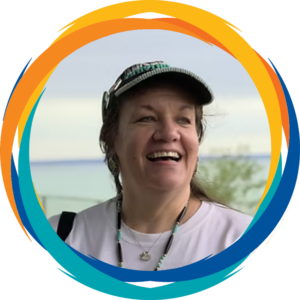
Andrea Pierce wears many hats. She’s a mother, a grandmother, an enrolled member of the Little Traverse Bay Bands of Odawa Indians, the Policy Director for Michigan Environmental Justice Coalition, and back in 2020 she was working to coordinate an action to try and stop a massive pipeline company in its tracks.
More recently, in November 2025 she joined Climate Justice Alliance’s delegation to the UN Climate Change Conference of Parties (COP 30) in Belem, Brazil. I caught up with her in January after she’d had some time to rest and reflect. Among many things, she shared about the trip to COP 30, her work in Michigan, and how she helped to discover evidence of a 10,000 year old cultural site in the Straits of Mackinac – right where the Line 5 tunnel is proposed to run.
The following is from our conversation on January 15th, 2026. This interview has been edited for length and clarity.
~
Mark Chavez
Can you tell me a little bit about yourself?
Andrea Pierce
Well, when you put it like that, that’s a hard one, but really, I’m an Indigenous woman. I grew up in Michigan. I am a mom. I’m a grandma. I’m an auntie, cousin. I’ve got a lot of friends. I guess I’m a warrior. I fight for our community. I fight for our people.
MC
You said you’re a warrior and you work to fight for the community–
AP
Communities. I’m from more than one community. I’m from up north: community with my tribe. I grew up downstate, so that’s a community. Now I have more ties to Detroit, so that’s another community.
MC
Communities, right. What does it mean for you to be accountable to those communities?
AP
Hmmm, to be accountable. I guess it’d be to be accessible to talk to them, to people. So if somebody needs something or if something’s going wrong or even if they call you up to say, “Hey, you did a good job.” I wanna be accessible. You can’t be accountable if nobody can talk to you.
MC
Totally.
AP
To me that’s number one. You have to have communication. I can’t walk into an area and say, “Oh, I’m gonna save you and go do stuff.” No, you gotta talk to people, find out what are the issues. You gotta learn the issues, you gotta learn it from multiple places.
MC
I wanna bring it to your job as Policy Director of the Michigan Environmental Justice Coalition. I noticed that your bio says that you started as an in the streets activist. What is the difference between those two roles?
AP
I would think the difference would be how you get the message to people. As an in the streets activist, I had worked with Detroit Light Brigade and Ann Arbor Light Brigade, and we went out to the streets, we had rallies, we lit things up, we got the issues out, we had speakers come out and talk for a couple of hours about whatever it was. Usually it was Line 5, that was what I fought really hard against. Now I’m providing one-pagers about the issues, and taking it places, still getting people together, going to [the capital in] Lansing, have people call legislators, to get the message out, to learn about the issues. ‘Cause if a lot of people don’t know what the issues are, they don’t understand. Or maybe they’re so busy, they haven’t been able to find out, why am I sick, why am I having these problems? What’s going on here? I’m just working, going to school, trying to keep my head up, taking care of kids. It’s all time consuming. Especially with groceries as high as it is and everything. It’s hard for people not to work two jobs.
MC
Moving into the new year, 2026, what are some of the key things that you’re gonna be fighting for, advocating for, trying to stop, things like that out in Michigan?
AP
Right now, we’re working against data centers. Two years ago legislation gave them all these tax exemptions. We’re bringing out the issues about data centers in the area, how much water they’ll take, how much electricity they’ll use, how the vibration and the humming will impact people and the animals nearby. And do we wanna have all of our land used up for data centers.
MC
How do you paint a vision of the future for people who may not understand the work we’re doing super well?
AP
That’s a hard one, because we can paint the picture of what we’re trying to build, but a lot of the other beliefs are that if you want that, then you do it on your own. They say they want a lot of the same things, but how do they get there? On their own, bootstraps, right? But we’re in a position now where bootstraps aren’t gonna help anything.
MC
Right.
AP
When I talk about the vibrations about the data centers, a lot of times I am in Republican areas. And it’s a non-partisan issue, so they come to hear this. What is this about? What’s happening in my community? And I’ll ask them, how many here hunt? How many people here fish? And they’ll put their hands up, and I’m like, well, the vibrations are 24/7 and they might affect the migration patterns of the deer. They may not come back here. Neither will the birds. So if you hunt for birds and animals, you may not have them. You may have to go elsewhere where they don’t have data centers. If they’re putting the water back into the lakes, rivers, and streams that they’re pulling from, it will be so hot it will cook the fish. So you won’t be able to fish. So I try to relate it to them in ways that make sense to them. This is our food. If you relate it to them, it sometimes makes a difference.
MC
That makes sense.
AP
We have resolutions all over the state of Michigan against Line 5 Tunnel and Pipeline. How did we do that? ‘Cause even my Washtenaw county community didn’t understand, ‘well that won’t impact us.’ ‘Really, losing 20% of the world’s fresh water won’t impact you?’ I said, ‘tourism, that won’t impact you? That loss, that huge amount of loss of people coming to Michigan, where they come through Washtenaw County, that won’t impact you?’ Then we get a resolution. You have to relate it to them, even though I’m not a hunter. My grandson likes to fish. I know hunters, I have hunters in my family. We hunt for food, not for sport. You have to relate the work to what is important to whom you are talking too,
MC
You mentioned Enbridge Line 5. I saw somewhere that you were involved in uncovering a cultural site in the Straits of Mackinac. How did that happen?
AP
During COVID. It was crazy. I was sitting at home and one of my friends called me up and said she had a friend that had a submarine and that we could rent it and see Line 5 and I said “DUDE I’d do anything to see Line 5. I’m in.” It was during COVID. We had to be sneaky about it because Enbridge is right there, and they would do everything in their power to stop us and they have more power than the city officials or governor, so we had to be careful. And we got the submarine. Well we had conflict issue, so we quit working with him and we got one of those ROVs. We had to actually get money. We took donations and had to get people to donate quite a bit of money for this and we had hooked it to a jiimaan which is a huge, old native canoe. They sit 10, 12 people. We hooked it to that. And they took it out. I was not there. My role was in the background. I was the one that had to find places for people to stay, get people to donate money, and also to give us time without telling them what we were doing. And we got a letter from different tribes saying that we had the right to be there as Indigenous people, so if we got stopped and it was a tribal issue, and they would be involved with their attorneys – we had one of those letters. I had to get that without telling people exactly what we were doing, because we didn’t want to tip off the wrong corporation. I literally called people up and said, ‘you know who I am. You know what I want to do. I need a letter saying this.’ ‘Do I have to get in the submarine?’-
MC
(laughing)
AP
‘No? All right. You got it.’ ‘I need you to come volunteer to be in the jiimaan (canoe). But I don’t know when. I’ll put your name on the list, and I’ll call. And if you can, you let me know.’ ‘Yeah, I’ll do that.’
MC
Wow.
AP
I had a boat pull us, too, just in case things went bad. We had a boat with us. So they ended up pulling the jiimaan so we could get the right speeds. It didn’t work well with the paddlers, and we still needed eight paddlers. It was crazy.
MC
Wait, wait, wait. Paint the picture for me. I’m hearing there’s a canoe, like a traditional Indigenous canoe being towed by a boat and an ROV? What is an ROV? I heard the word submarine. What happened that day?
AP
It was several days. This was months. We worked on this like all summer long, right? We had the submarine guy. We had to pay him. So we had to get money for that. We had a conflict with him and he’s no longer working with us. Well, now what do we do? So that was when we thought to get an ROV, we had to get one from Canada. During COVID, now remember, this is all during COVID. You’re not allowed out of your houses.
MC
You’re still rubbing bleach on your groceries when you bring ’em home. That era of COVID?
AP
Yes, yes, yes. I think it happened during June, July. Maybe August at the latest. Early in the COVID times.
MC
Wow.
AP
I’m still in the basement, also making masks for people, you know? Because I’ve sent out masks to a bunch of elders and tribal people. And if you had kids, or if I knew you were sick, I just sent them, and this is before masks were even supposed to be worn. I’m like, I don’t believe what’s happening. I don’t want to go to your funeral. Please wear the damn mask. Right. But if you need more, let me know. And so that’s what we were doing. And just trying to reach out to people. Most of it, like I said, was over the phone because nobody wanted you near them. So it’s not like we could have a secret code thing, you know? And I’m being as secretive as I can over the phone with people. Like I said, I broke it down to you know who I am. You know what I’m trying to do. This is what I need. I can’t tell you anything else.
MC
This was Andrea pulling all the favors. You were like, this is me cashing in.
AP
How bad do you want to help me do this? Because you know where I am– I want to shut this damn thing down. Where are we at?
MC
And why is this so important to you?
AP
We were discussing at one of the meetings the tribe held that Enbridge is going to be digging up our ancestral remains on both sides of the Straits of Mackinac. It’s a burial mound, where people years ago buried their dead, with ceremonies, that’s our family on both sides. Enbridge just said they’re going to be digging them up. Either you get rid of them or we do, basically, is what we were told.
Mark
Wow.
AP
Right? It’s terrible. And we’re concerned about missing murdered indigenous women and children and men while they’re building the tunnel. So truthfully, as an indigenous person in Michigan right now: I don’t feel safe, dead, or alive. I mean, how’s that? You’re going to kill me now, and then what are you going to do with my body later? So it’s scary. And then you throw ICE in the mix. It’s terrifying times. And then we got this company, this big company. And we have no choice on this. Nothing.
MC
That is horrible. And that has not happened yet?
AP
Not yet.
MC
Not. Let’s keep it at: that hasn’t happened. And with all of the power that you and your community have, the goal is to make sure it never happens because those are sacred places, they are very important for lots of reasons and that should be respected regardless of your ancestry and your belief system?
AP
Exactly. Why do they always dig up our remains? Everybody else’s remains are fenced up, worshipped and sacred.
MC
To zoom out a little bit, you spent part of November 2025 in Brazil. Can you contextualize what COP30 is? How do you describe COP30 to a family member who knows nothing about the work you do?
AP
Yeah. I would say that COP30 is an international climate conference where people are coming from all over the world to discuss the problems, issues, and how it’s affecting their places where they live and try to find a way to make it better for impacted communities. That would probably be the easiest way. While having a lot of fossil fuel executives around. Because we can’t forget that, right? It sounds perfect, all these people coming together to talk, But yeah, we did have what was it? What was it? 1,600? It was a huge amount of fossil fuel representatives who are also from all over the world, right? And we didn’t know who they were. It was actually to the point that we were given stickers. I am NOT a fossil fuel executive.
MC
(Laughing)
Were there things that surprised you, or have really stuck with you a few months later?
AP
Well, I think a big surprise was that all over the world, we’re all fighting for the water. And a lot of it’s from the same things, right? I mean a lot of people are fighting data centers in different countries and the contamination and wasting of the water. That was surprising because I thought, me being here, that this was just something really happening in the United States. Because I read the papers, I check out the news and it sounds like the other countries are leaps and bounds ahead of us when it comes to transiting fossil fuel and getting rid of our reliance. You hear about streets paved with those wires so that when you drive your car down there, your EV gets charged. And I’m like, oh, that’ll never happen here until they figure out how to charge us for it. We’d have a bill by the time we get home. Cha ching, oh, this costs $2,000 to charge your car.
MC
Something like that.
AP
It really validated and confirmed to me that our issues are all over the world, and they are all important. And that so many people are fighting the same thing, and that we need a bigger voice. We need to be heard. I really liked the Indigenous Peoples Caucus. It was people from all over the world talking about issues and working on the issues that were prevalent at COP. The black descendants got so many hectares of land back in Brazil. We have to do everything we can to save the Amazon rainforest. Now that I’ve seen it, or parts of it, I’m amazed. We have to do everything in our power to save that and our Great Lakes, which is just as important. Also, the coral reefs, they all work together to make the world we live in. And there’s other places too, those are just the three I just thought of right off the top of my head.
MC
Yeah.
AP
It was a wonderful trip.There was one lady at the gathering for the Rights of Nature, for hours they had people come up and they would talk about different things in their own language. This African woman, she came and spoke in her own language and was talking about how important the Earth is to us and we have to have this connection to the Earth so that she knows who we are and that we have to fight to get this connection back. And it was hot. It was murderously hot. They had these great big air conditioners in an outside place which seemed counterproductive to me. I sat right next to one.
She got down on her hands and knees, and she started chanting to the earth and all of a sudden the rain came down. And there were thunder beings, thunder everywhere and I’m sitting there like “whoa, this is crazy I had goosebumps and Mar [Zepada] looks at me and she goes “rain was not in the forecast for today.”
MC
Wow.
AP
Yeah, and I saw the connection. That’s what she’s talking about, we need to have this connection that when you’re talking to the earth, they respond. They responded. It was–I had chills for days.
MC
I’ve got chills right now. To wrap things up, can you share something that you would love for more people to hear, or watch, or read that has nothing to do with your work but is really inspiring to you?
AP
See, hear, or read. Well I’ve really been into the books by Angeline Boulley. She’s from Upper Michigan and I think she’s on her third one and I really enjoy reading those. I’ll get one for my daughter. I order mine, I get one for my daughter, I support Indigenous artists. But she’s really done really, really well with the books. I enjoy them.
And it’s nice to read Indigenous stories, that are set in modern day times, where it’s normal and real. Because a lot of our stuff is way back when. And people think we’re dead. We’re extinct. I like the newer stuff, where people see the Indigenous are still alive and doing things.
MC
Yeah definitely.
Well, that’s all the time we have for today. Thank you so much for your time Andrea, we’ll talk soon.
AP
Thank you, thank you. Bye!