
Policy
Building our Power by Changing the Rules
Centering Frontline Solutions
CJA’s policy work is guided by nearly 100 environmental justice, frontline and supporting organizations engaged in local, state and national work on a wide range of issues from Racial Justice, Housing Justice, Energy Democracy, Food Sovereignty, Zero Waste, Just Recovery Work, Resiliency Hubs and more. Our 6 meta strategies guide our vision for a Just Transition to a Regenerative Economy.
When it comes to policy work, those closest to the problems have the most innovative solutions, and are the experts on the issues affecting their lives.
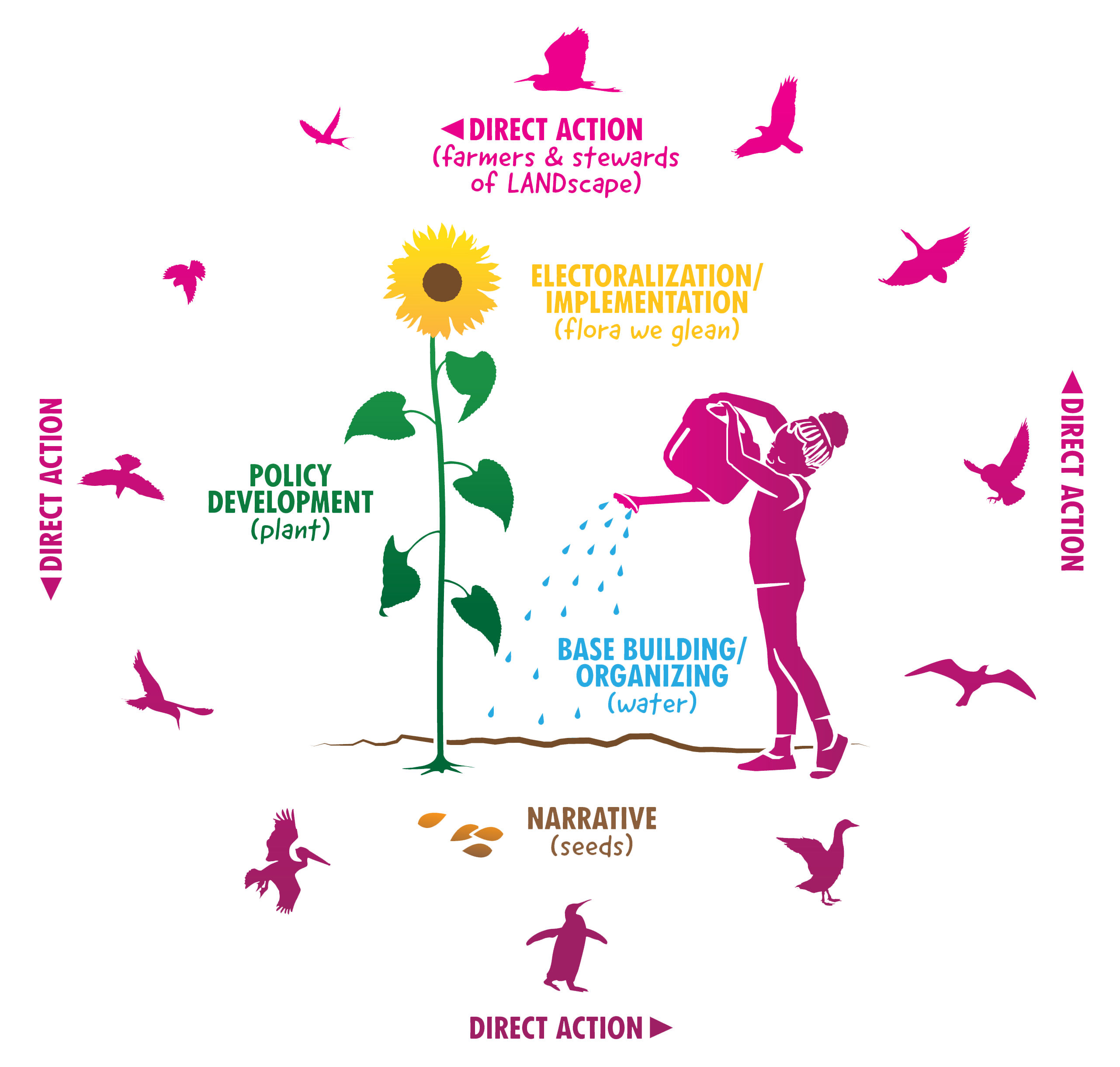
Policy Grounded in Community Wisdom
Those closest to the problems are best equipped to build the solutions. Our policy team bridges the gap between our members’ local frontline expertise and the halls of power, ensuring that those communities most impacted by climate change are the ones driving the legislative agenda.
- From Voices to Solutions: Whether it’s a new data center moving into your neighborhood or a federal regulation with public health risks, we turn community needs into actionable policy.
- Respecting Sovereignty: We advocate for Free, Prior, and Informed Consent (FPIC) to uphold Tribal sovereignty and honor Indigenous knowledge.
- A Just Transition for All: By championing energy democracy, food sovereignty, and just recovery we fight for municipal and federal policies that protect workers and families in every zip code, regardless of political persuasion.
Find our most recent positions below:
- EJ Organizations Demand Justice in face of the EPA Revoking the Endangerment Finding (Feb. 12, 2026)
- Climate Justice is Migrant Justice and Communities are Rising (Feb. 8, 2026)
- Climate Justice Alliance Condemns Trump’s Move to Pull the U.S. out of International Bodies (Jan 9, 2026)
- Climate Justice Alliance Submits Public Letter with 17 EJ Organizations to Oppose More Handouts to Polluting Industries (Jan. 13, 2026)
Check out our Newsroom for information about the latest developments on climate justice related policies.
Fact Sheets, Policy Guides & Other Resources
Use these tools to educate yourself and your community, and to advance your local, state, federal and tribal efforts toward a Regenerative Economy.
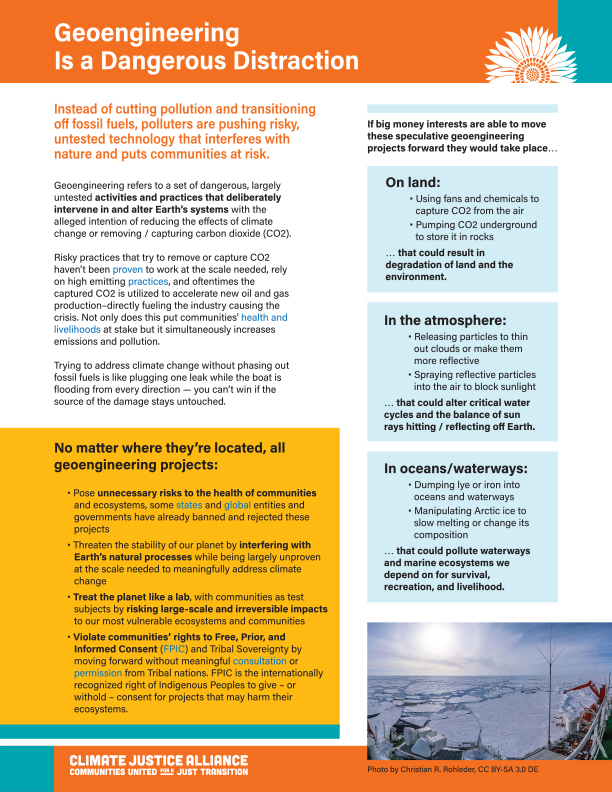
Geoengineering is a Dangerous Distraction Fact Sheet
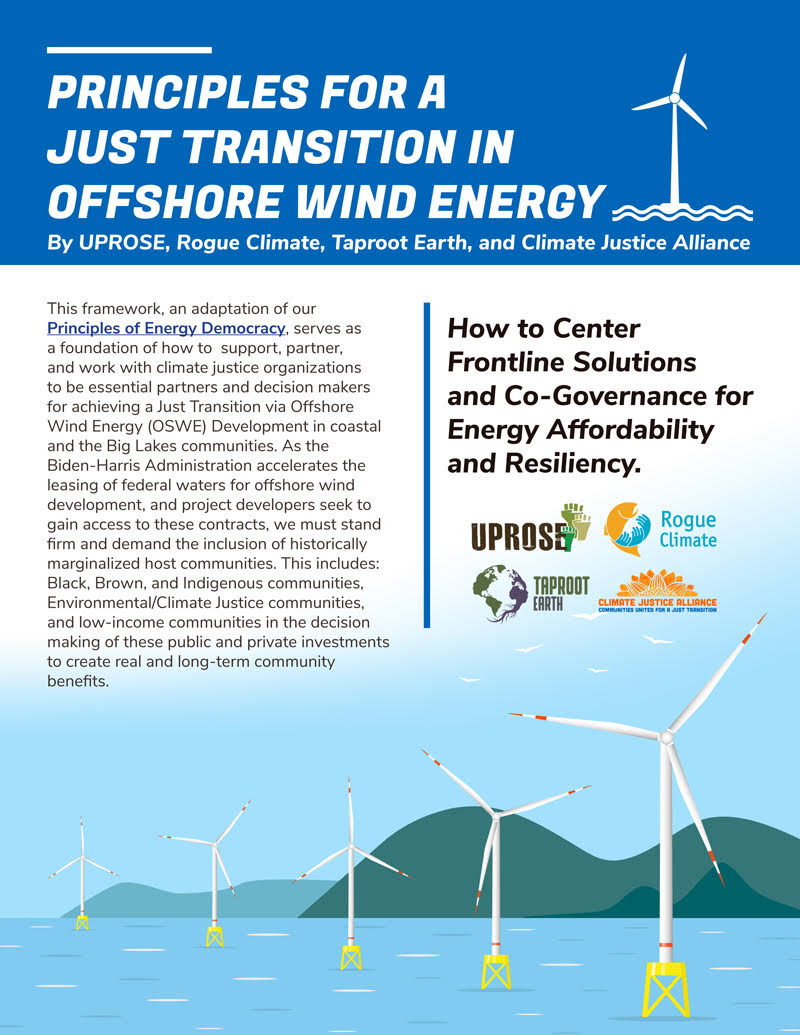
Principles for a Just Transition in Offshore Wind Energy – How to Center Frontline Solutions
and Co-Governance for Energy Affordability and Resiliency.
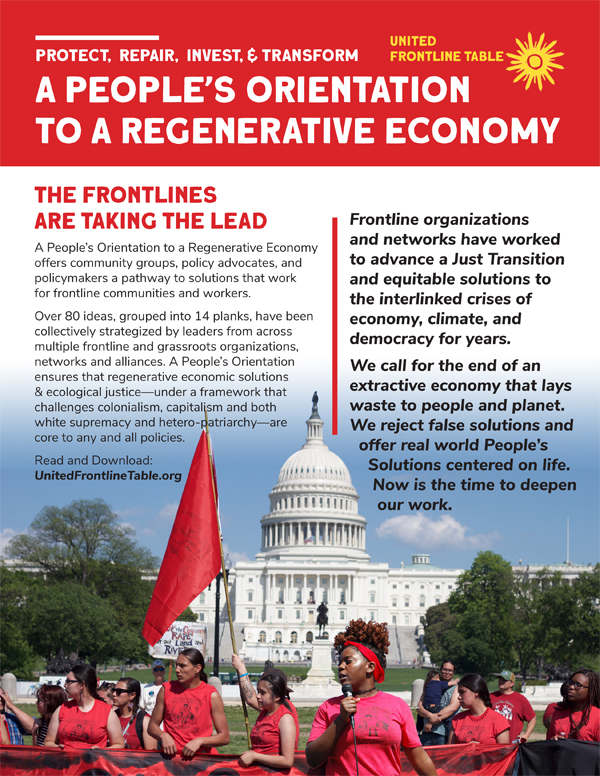
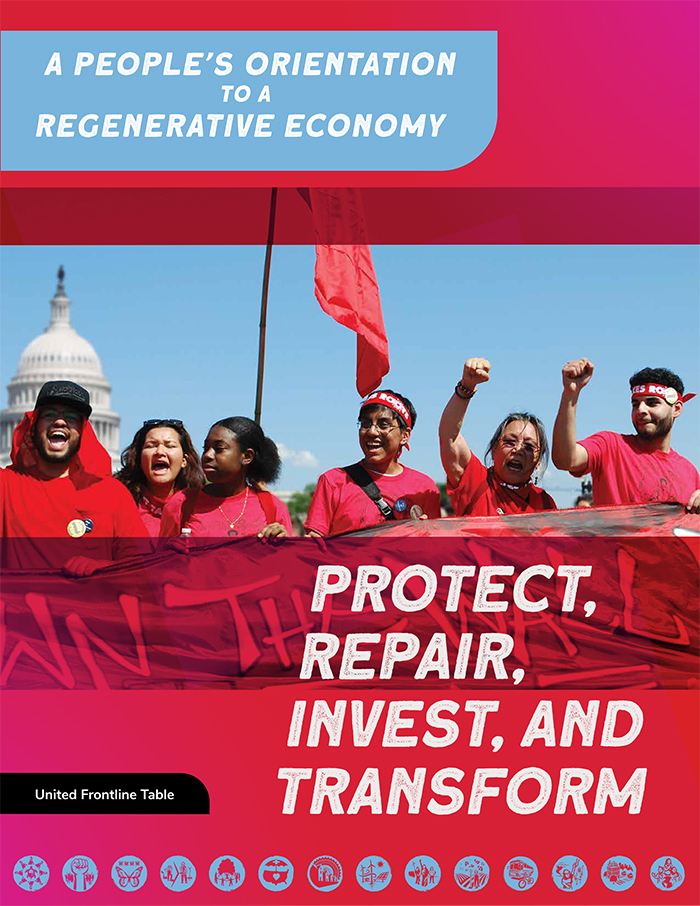
80 policy ideas, grouped into 14 planks
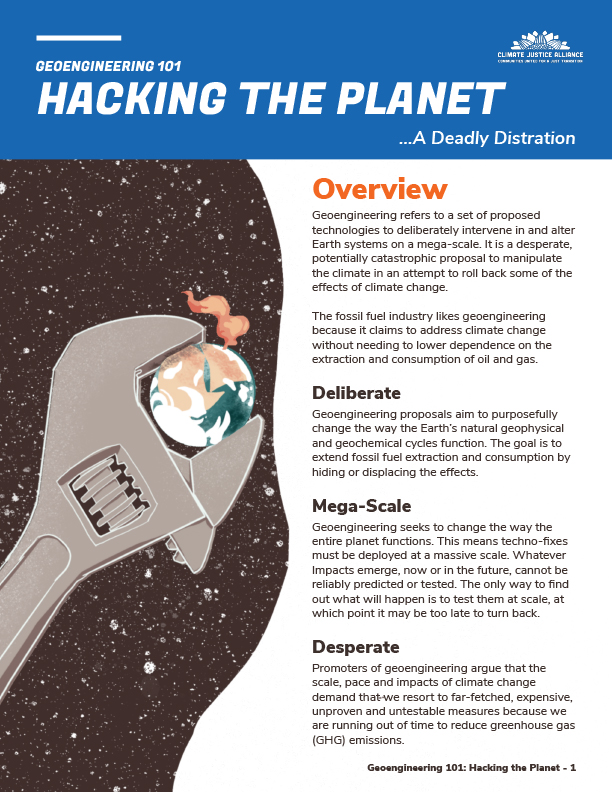
Read about geoengineering experiments and download fact sheets on Hacking the Planet, Carbon Capture & Storage, Solar Radiation Management.
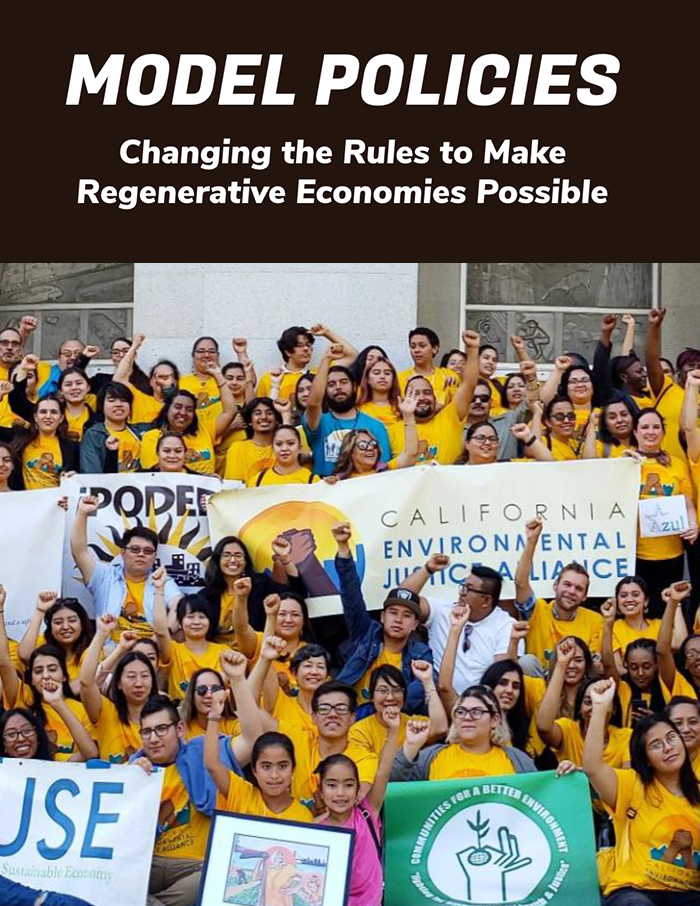
Key model policies to move power and resources to frontline communities.
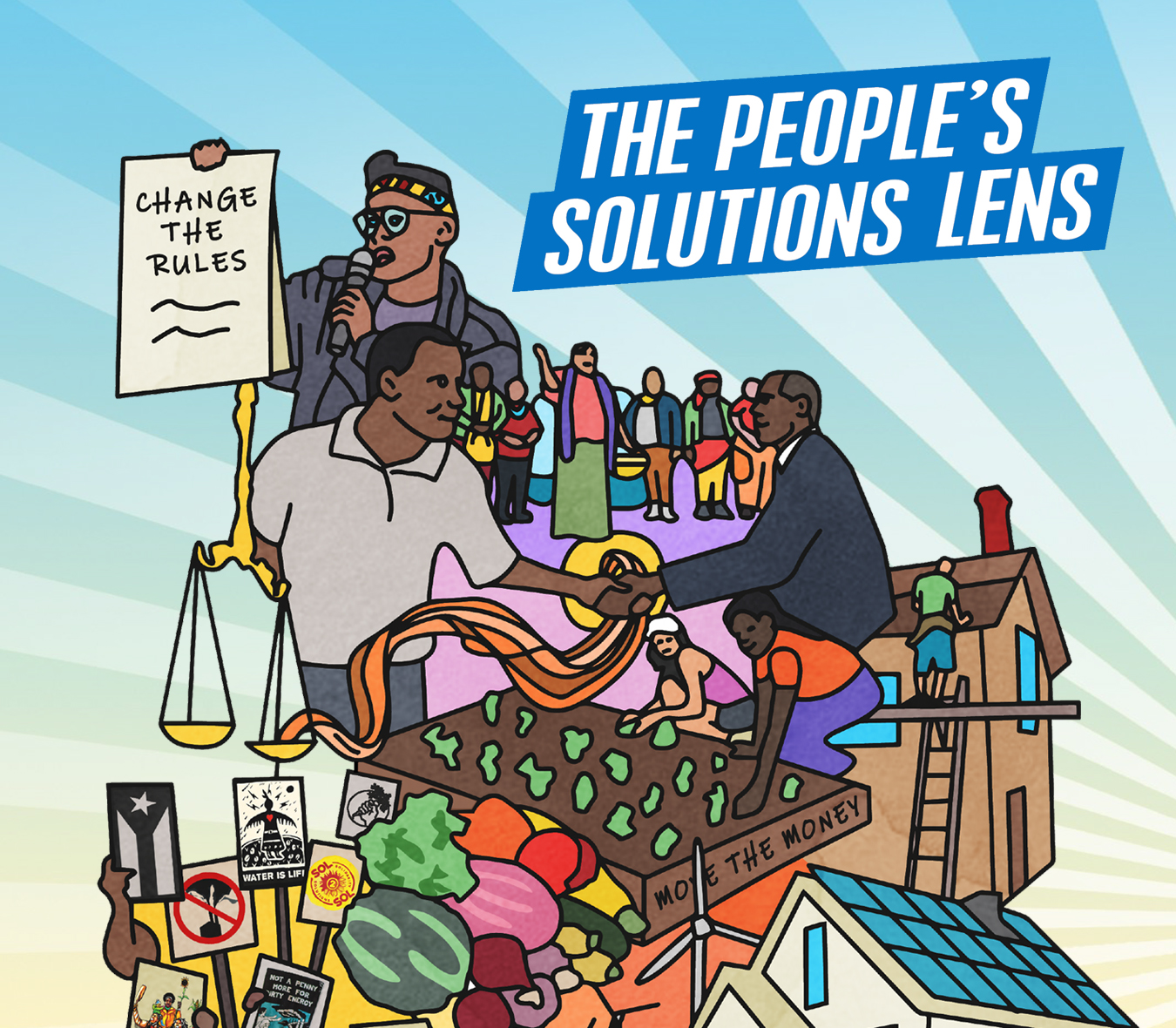
The People’s Solutions Lens
It can be difficult to keep up with the ever-changing world of climate solutions, and not all “solutions” are inherently equitable or just. Fortunately, we’ve identified five straight-forward questions that can help you separate false solutions from the real deal. Use the People’s Solutions Lens to determine whether the various policy proposals are rooted in justice for workers, frontline communities, and the environment:
1Who tells the story?
Frontline communities and workers are impacted first and worst by the interlinked crises of climate change and the extractive, exploitative economy. We speak for ourselves, and hold the wisdom, vision, and organizing power to lead climate and economic solutions. Yet, often times, others claim to speak for us without necessarily representing our interests. As we often say, nothing about us without us is for us.
2Who makes the decisions?
The environmental justice movement defines environment as “where we live, work, play, and pray.” Whether it’s the factory floor or the neighborhood, those closest to the problems will inevitably know the most about what the solutions need to look like. For any other climate or economic policy to truly work for Indigenous Peoples, Black communities, immigrants and refugees of color, and working class communities, it must embody the practice of community self-determination.
3Who benefits, and how?
The climate crisis is ecological, but it has its roots in systemic inequity that is racial, gendered, and economic. To address these root causes, authentic climate and economic policy solutions must flip the existing dynamics around racial injustice, wealth extraction, and labor exploitation.
4What else will this impact?
Sometimes environmental and climate policies or “solutions” can create new problems for other issues that we care about— e.g. workers’ rights, housing, economic development, immigration, policing, mass incarceration, etc. Real solutions must work for ALL of our issues. No false solutions. No more sacrifice zones.
5How will this build or shift power?
To address the climate crisis at scale, individual and collective solutions must put us in a better position to pursue subsequent solutions. Transformative solutions, then, must do more than accomplish individualized goals, specific policies, or select elections; they must shift the landscape of political, economic, and cultural power such that subsequent goals become more attainable. Climate and economic policy proposals must be organizing tools that bring together a mass movement of people, workers, and communities. This is imperative to ensure the implementation phase is both inclusive and equitable.
This tool was based on a version from Labor Network for Sustainability and Climate Justice Alliance, adapted from the original People’s Solutions Lens—a collaborative creation by It Takes Roots (a frontline formation composed of Climate Justice Alliance, Grassroots Global Justice Alliance, Indigenous Environmental Network, and Right to the City Alliance) and their Funder Support Circle.